

Why? 10 Everyday Things We See Every Day but Rarely Ask About
Have you ever looked at something you see almost every day and suddenly wondered, “Why is it like that?”
Most of us don’t.
We walk over railway tracks, drive on roads, drink from plastic bottles, switch on ceiling fans, use electrical plugs, and look through airplane windows without giving much thought to their design. These things are so familiar that our brains simply accept them as normal.
But behind many ordinary objects and everyday systems, there is a surprisingly good reason for the way they are designed.
These everyday mysteries are all around us, but we rarely stop to ask why things are designed or behave the way they do.
Some were created because of science. Others developed because of safety, convenience, history, or simple engineering logic.
So, let’s start asking a few of those questions.
Welcome to the first article in our “Why?” series, where we explore the everyday mysteries hiding in plain sight.
Everyday Mysteries Are All Around Us
Everyday mysteries are all around us, from the stones beneath railway tracks to the shape of an airplane window. We see these things so often that we rarely stop to ask why they were designed this way.
1. Why Are Stones Used Under Railway Tracks?
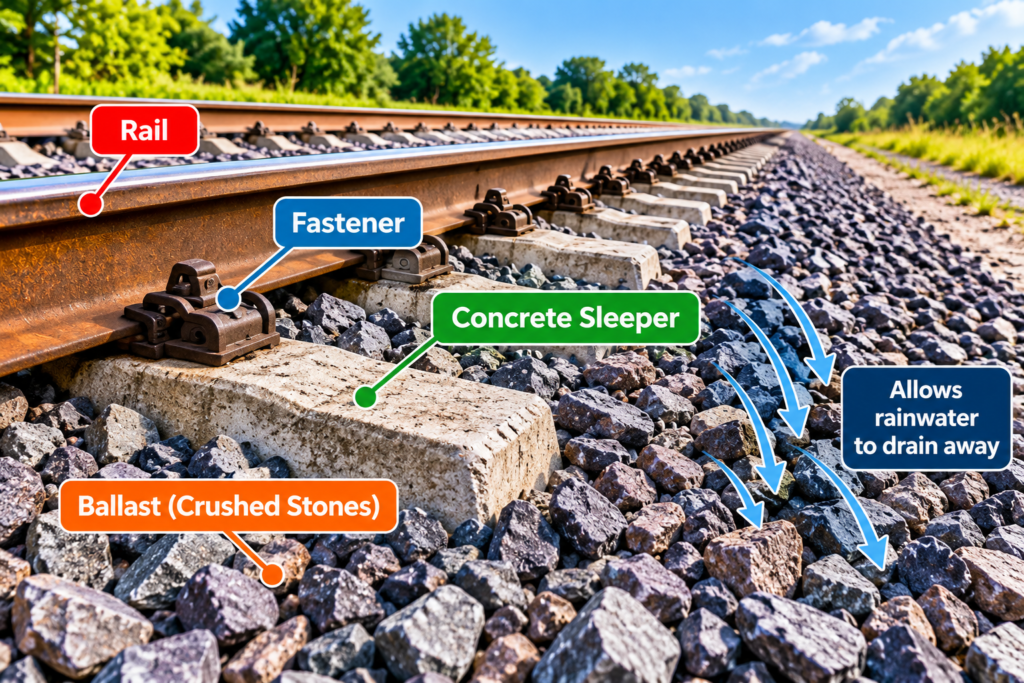
If you look at a railway line, you will notice that the rails are not sitting directly on the ground. Underneath them is a thick layer of crushed stones.
These stones are called railway ballast.
But why stones?
They Help Support the Weight of Trains
A railway train can weigh hundreds or even thousands of tons. When that enormous weight passes over a relatively narrow track, the force needs to be distributed safely into the ground.
The ballast helps do exactly that.
The stones sit underneath and around the railway sleepers, which are the concrete, wooden, or composite supports holding the rails in position. Their irregular, angular shapes allow them to lock together and create a stable foundation.
This helps prevent the sleepers and rails from moving when heavy trains pass over them.
They Allow Rainwater to Drain Away
There is another very important reason for using stones: drainage.
When it rains, water needs somewhere to go. If water collected underneath railway tracks, the soil could become soft and unstable.
The gaps between the stones allow rainwater to move away from the track instead of remaining trapped underneath it.
Why Are the Stones Crushed and Angular?
You may have noticed that railway ballast doesn’t usually consist of smooth, rounded stones.
That’s intentional.
Sharp, angular stones interlock with each other. This makes the ballast much more stable. Smooth stones would move and roll much more easily under the repeated vibration and pressure produced by passing trains.
So those stones are doing much more than simply sitting underneath the railway.
They are part of the engineering system that keeps the railway stable, properly drained, and safe.
2. Why Are Car Tires Black?
Natural rubber isn’t naturally black.
So why aren’t car tires white, gray, or brown?
The answer is largely related to a material called carbon black.
[H3] Carbon Black Makes Tires Stronger
When manufacturers make modern tires, carbon black is added to the rubber compound.
One important benefit is resistance to wear. Tires constantly rub against roads, and that friction gradually wears the rubber down. Carbon black helps strengthen the rubber and allows tires to last much longer.
It also helps protect rubber from ultraviolet radiation. Sunlight can gradually damage rubber and make it deteriorate.
[H3] It Also Helps With Heat
Tires generate heat while a vehicle is moving, particularly at high speeds. Carbon black contributes to the tire’s ability to manage heat.
The result is a tire that is more durable and practical for everyday driving.
So the black color isn’t simply a fashion choice.
Your car tires are black largely because the material that helps make them stronger and more durable is black.
3. Why Do Roads and Bridges Have Gaps?
Have you ever noticed gaps between sections of concrete roads, bridges, sidewalks, or other large structures?
At first glance, they might look like imperfections.
Actually, they are often there deliberately.
Materials Expand When Heated
The main reason is thermal expansion and contraction.
Materials expand when they become warmer and contract when they become colder. Concrete and steel are no exception.
Imagine building a very long concrete structure with absolutely no room for expansion. When temperatures rise, the concrete wants to expand.
But if it has nowhere to go, enormous forces can build up inside the structure.
Eventually, the concrete could crack, buckle, or become damaged.
[H3] Expansion Joints Give the Structure Room to Move
Expansion joints provide controlled spaces where materials can expand and contract without causing the entire structure to fail.
Bridges need this particularly because they are exposed to temperature changes. They also experience movement caused by traffic, wind, and other forces.
So those gaps aren’t necessarily signs of poor construction.
Quite the opposite.
The gap may be evidence that engineers planned for the structure to move.
4. Why Are Airplane Windows Rounded?
Look at an airplane window and compare it with a normal window in a house.
A house window is often rectangular with sharp corners.
An airplane window is usually rounded or has noticeably curved corners.
This design is closely related to air pressure and structural strength.
Airplanes Experience Major Pressure Differences
At cruising altitude, the air pressure outside an aircraft is much lower than the pressure maintained inside the passenger cabin.
The aircraft structure therefore has to withstand a significant pressure difference.
Sharp corners can concentrate stress around the edges of an opening.
A rounded shape distributes stress more evenly around the opening.
[H3] Rounded Shapes Reduce Stress Concentration
This became an especially important lesson during the early development of pressurized aircraft.
Engineers learned that the shape and design of openings in an aircraft fuselage could have major consequences for structural safety.
Modern aircraft windows are also made with multiple layers and are carefully designed as part of the aircraft’s overall pressure system.
So those little rounded windows aren’t simply designed that way because they look nicer.
Their shape is an important part of the aircraft’s structural engineering.

According to the U.S. Geological Survey, ice is less dense than liquid water, which is why ice cubes float.
5. Why Does Ice Float on Water?
Here’s one of the strangest things about water.
Most substances become denser when they turn from a liquid into a solid.
Water behaves differently.
Ice floats.
Why?
Water Expands When It Freezes
When water freezes, its molecules arrange themselves into a more open structure.
This structure takes up more space than the same amount of liquid water.
As a result, ice is less dense than liquid water.
That’s why a piece of ice floats instead of sinking.
[H3] Why Is This Important for Life?
This unusual property has enormous consequences for life on Earth.
Imagine if ice were denser than liquid water and sank to the bottom of lakes every time it formed.
In very cold climates, bodies of water could potentially freeze from the bottom upward.
Instead, floating ice forms a layer on the surface. That layer can help insulate the water underneath, allowing aquatic life to survive in cold conditions.
So the next time you drop an ice cube into a glass of water, you’re looking at something quite unusual.
Ice floats because frozen water takes up more space and therefore becomes less dense than liquid water.
If you enjoy discovering interesting facts about the world, you may also want to read our guide to the [Top 10 Largest Countries in the World].
6. Why Do Ceiling Fans Usually Have Three or Four Blades?
Have you ever wondered why most ceiling fans don’t have ten blades?
After all, wouldn’t more blades produce more air?
Not necessarily.
A ceiling fan has to find a balance between air movement, motor power, noise, and energy consumption.
More Blades Don’t Always Mean More Air
Adding more blades can increase the amount of air the fan interacts with, but it also increases resistance and puts additional demands on the motor.
More blades don’t automatically mean better airflow.
The shape, angle, length, and speed of the blades are also important.
It Is About Balance
Modern ceiling fans are designed with a particular combination of blade number and shape that provides useful airflow without requiring excessive power.
Some fans have three blades, others four, five, or even more. Different designs are optimized for different purposes.
So there isn’t a magical rule saying that three blades are always best.
A good ceiling fan isn’t designed to have as many blades as possible. It is designed to move air efficiently.
Aircraft design guidance has long recognized the importance of rounded corners and carefully designed window openings. NASA technical guidance on aircraft windows
7. Why Do Plastic Bottles Have Ridges?
Look at an ordinary plastic soft-drink or water bottle.
Many bottles have grooves, ridges, or carefully shaped curves.
Why not make the bottle completely smooth?
Ridges Make Bottles Stronger
Those shapes can provide strength and stability while using relatively little plastic.
A completely thin, smooth plastic container can easily buckle when squeezed.
Ridges and curves can make the structure more resistant to deformation.
They can also make bottles easier to grip.
Less Material Can Mean Lower Weight
For manufacturers, there is another major advantage.
Good bottle design can achieve the required strength without simply making the entire bottle much thicker.
Using more plastic would increase the weight, cost, and environmental impact of the container.
These everyday mysteries are all around us, but we rarely stop to ask why things are designed or behave the way they do.
So a simple-looking groove can actually be an example of efficient engineering.
Those ridges aren’t just decoration. They help the bottle remain strong while keeping the amount of material relatively low.

8. Why Do Electrical Plug Pins Sometimes Have Holes?
Have you ever looked at the metal pins of an electrical plug and noticed small holes near their ends?
It is easy to assume that they’re completely unnecessary.
The purpose depends on the particular plug and socket design.
The Holes Can Have Different Purposes
In some designs, holes in the pins are associated with mechanical retention. Certain socket contacts can engage with parts of the pin in ways that help hold the plug securely.
In other designs, the holes can be related to manufacturing methods.
It is important to remember that not every plug uses these holes for exactly the same reason.
Some modern plug designs don’t have them at all.
Small Details Can Have Practical Reasons
This is a good example of something that looks mysterious but actually comes from practical engineering decisions.
The next time you unplug an appliance, take a look at the pins.
That tiny hole is a reminder that even very small details in everyday objects can have a purpose.
9. Why Do Coins Have Ridged Edges?
If you run your finger around the edge of some coins, you’ll feel tiny lines or ridges.
Why?
There is an interesting historical reason.
Ridged Edges Helped Prevent Coin Tampering
In the past, some coins were made from valuable metals such as gold or silver.
A dishonest person could potentially shave a small amount of metal from the edge of a coin and keep the valuable material while continuing to use the coin.
The coin might still look almost normal.
Ridged edges made this type of tampering easier to notice.
If someone shaved metal from a ridged coin, the altered edge would become visibly different.
The Design Still Has Uses Today
Today, ridged edges have become a familiar feature of many coins.
The reasons for particular edge designs vary. Coin edges can also help people distinguish between denominations and can provide additional security features.
So those tiny lines are connected to a problem that existed centuries ago.
A simple pattern around the edge of a coin became a clever way to discourage people from secretly removing valuable metal.
10. Why Do Houses Have Gutters and Downpipes?
When rain falls on a roof, where does all that water go?
Without a drainage system, it would simply run off the edges of the roof wherever gravity takes it.
That might sound harmless, but concentrated water falling next to a building can cause serious problems.
Gutters Collect Rainwater
The gutter collects rainwater from the roof and directs it toward specific points.
Without gutters, large amounts of water can fall directly beside the building, potentially eroding soil, splashing water onto walls, damaging landscaping, and contributing to water reaching the foundation.
Downpipes Control Where the Water Goes
The downpipe then carries the water safely toward the ground.
Depending on the building, the water may be directed into a drainage system, a rainwater collection tank, or another suitable outlet.
In areas that receive heavy rainfall, good roof drainage is particularly important.
A simple gutter may look like an ordinary piece of plastic or metal attached to a roof, but it performs an important job.

It turns uncontrolled rainwater into controlled drainage.
The World Around Us Is Full of “Why?”
The interesting thing about these examples is that most of them don’t look mysterious.
We see railway tracks.
We drive over roads.
We drink from bottles.
We plug in electrical appliances.
We sit under ceiling fans.
We use coins.
We walk into buildings during the rain.
Because these things are so familiar, we rarely stop and ask why they are designed the way they are.
But once you start asking questions, ordinary objects become much more interesting.
A railway track becomes a lesson in engineering.
A black tire becomes a lesson in materials science.
An airplane window becomes a lesson in pressure and structural design.
A piece of ice becomes a lesson in molecular behavior.
And a tiny ridge on a coin takes us back to the history of money and attempts at fraud.
That’s the idea behind our “Why?” series: exploring the everyday mysteries hidden in the ordinary things around us.
In the next article, we’ll look at more everyday things that we see all the time—but rarely stop to ask:
“Why is it like that?”
Because sometimes, the most interesting discoveries are hiding in the things we have stopped noticing.