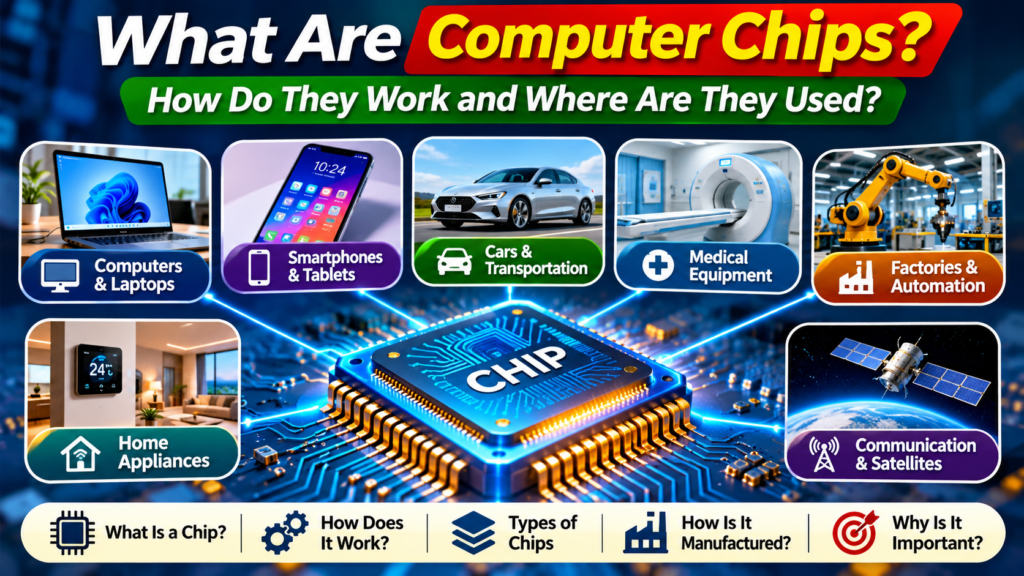
What Are Computer Chips? How Do They Work and Where Are They Used?
Imagine switching on your smartphone, starting your car, watching television, using an ATM or even operating a modern washing machine. These activities seem completely different, but they have something important in common: they depend on tiny electronic components called computer chips.
Computer chips are among the most important inventions in modern technology. They help devices process information, store data, control operations and communicate with other systems. Without them, most of the electronic products we use every day would not work as they do today.
But what exactly is a computer chip? How can such a small object perform millions or billions of operations? What is inside it? And where are these chips used?
Understanding what are computer chips and how they work helps us understand the technology behind our modern world.
Let’s explore the world of computer chips in simple language.
1. What Is a Computer Chip?
A computer chip, also known as a microchip or an integrated circuit (IC), is a small electronic component made from semiconductor material, usually silicon.
It contains tiny electronic components and connections arranged together to perform specific functions. Depending on its design, a chip may process information, store data, control a machine, manage electrical power or handle communication.
You can think of a computer chip as a small electronic control centre. It receives information, follows instructions and produces an output.
For example:
- A chip inside a smartphone helps run applications and process information.
- A chip inside a digital camera helps process images.
- A chip inside a car helps control engine functions and safety systems.
- A chip inside a washing machine manages washing programmes and water levels.
Not all chips perform the same job. Some are designed for calculations, some for memory, and others for controlling specific electronic functions.
2. What Are Computer Chips Made Of?
Most modern computer chips are manufactured using silicon, a semiconductor material.
Silicon is obtained from silica, a material found in nature, including sand and quartz. However, manufacturing electronic chips requires extremely pure silicon. Ordinary sand cannot simply be turned directly into a working computer chip.
Why is silicon used?
The main reason is that silicon has useful electrical properties. It is neither a perfect electrical conductor nor a complete insulator. Its ability to control the flow of electricity makes it suitable for building tiny electronic switches and circuits.
Other materials are also used in semiconductor manufacturing, including metals, insulating materials and carefully selected chemical elements.
A finished chip may contain:
- Transistors
- Tiny electrical connections
- Insulating layers
- Other electronic components
All these elements are arranged in carefully designed patterns on a very small piece of semiconductor material.
3. What Is Inside a Computer Chip?
One of the most important components inside a computer chip is the transistor.
A transistor is a very small electronic device that can act as a switch or, in some applications, amplify an electrical signal.
Think about an ordinary light switch. When you turn it on, electricity can flow through the circuit. When you turn it off, the flow is interrupted.
A transistor performs a similar switching function, but on a microscopic scale and under electronic control.
Modern chips can contain millions or even billions of transistors. These transistors work together to perform complicated operations.
A chip also contains:
- Logic gates that perform basic logical operations.
- Memory elements that hold information.
- Electrical pathways that connect different parts of the circuit.
- Control circuits that coordinate operations.
The remarkable achievement of semiconductor technology is that so many components can be placed on a tiny piece of material and made to work together.
4. How Do Computer Chips Work?
To understand how a computer chip works, we first need to understand how electronic devices represent information.
Computers use a system called binary, which represents information using two digits:
- 0
- 1
These two values are commonly associated with two different electrical states in digital circuits.
A transistor can be controlled to represent an electronic ON or OFF state. By combining large numbers of transistors, chips can represent and process complex information.
For example, when you type a message on your smartphone:
- You press a letter on the keyboard.
- The phone converts your action into digital information.
- The processor receives and processes the information.
- Other components help display the letter on the screen.
- The operating system and application manage what happens next.
This process happens extremely quickly.
In a computer, a processor generally follows a cycle involving three important activities:
Fetch: It obtains an instruction from memory.
Decode: It interprets what the instruction requires.
Execute: It performs the requested operation.
The processor repeats these activities continuously while running software.
A simple example is adding two numbers. The processor receives the instructions and data, performs the calculation and makes the result available to the rest of the system.
More complicated tasks, such as playing a video, running a game or processing artificial intelligence applications, involve many operations working together.
5. Different Types of Computer Chips
There are many types of computer chips. They are designed for different purposes, and modern electronic devices often contain several different types.
A. CPU – Central Processing Unit
The CPU is commonly described as the brain of a computer.
It executes instructions, performs calculations, makes logical decisions and coordinates many activities within a computer system.
CPUs are used in:
- Desktop computers
- Laptops
- Servers
- Smartphones
- Tablets
- Other electronic devices
B. GPU – Graphics Processing Unit
A GPU is designed to handle large numbers of calculations, particularly those needed to create and process graphics.
GPUs are important for:
- Computer games
- Video editing
- 3D graphics
- Scientific calculations
- Artificial intelligence applications
Unlike a general-purpose CPU, a GPU is designed to perform many similar calculations in parallel. This makes it useful for certain highly demanding workloads.
C. Memory Chips
Memory chips store information that electronic devices need.
Two familiar examples are:
RAM (Random Access Memory): Stores information temporarily while a computer or smartphone is operating. Its contents are generally lost when the device is switched off.
ROM and Flash Memory: These are examples of non-volatile memory technologies that retain information without continuous power. Flash memory is widely used in USB drives, memory cards and solid-state storage devices.
D. Microcontroller Chips
A microcontroller is a small computer system integrated into a single chip. It typically includes a processor, memory and input/output functions.
Microcontrollers are used to control specific tasks in:
- Washing machines
- Air conditioners
- Microwave ovens
- Automotive systems
- Industrial machines
- Smart home devices
E. AI Accelerator Chips
Artificial intelligence applications can require enormous amounts of mathematical computation.
AI accelerator chips are specially designed to perform certain AI workloads efficiently. They can be used for image recognition, speech processing, language models, recommendation systems and other machine learning tasks.
Some AI accelerators are designed for large data centres, while others are built into smartphones and other smaller devices.
F. Sensor and Communication Chips
Sensor chips help electronic devices detect changes in their surroundings, such as movement, temperature, pressure or light.
Communication chips help devices connect through technologies such as Wi-Fi, Bluetooth, mobile networks and other wireless systems.
6. Where Are Computer Chips Used?
Computer chips are no longer limited to computers and smartphones. They are used in almost every major area of modern life.
Let’s look at some important examples.
Smartphones and Tablets
A modern smartphone contains multiple chips that work together.
They may handle:
- Processing and running applications
- Touchscreen operations
- Camera image processing
- Wireless communication
- Memory and storage
- Power management
- Location and navigation functions
This is why a smartphone is effectively a small computer that fits in your pocket.
Computers and Laptops
Computers use chips for processing, memory, graphics, storage control, networking and many other functions.
The CPU executes instructions, memory chips hold active information, and graphics processors help produce images and videos.
Cars and Transportation
Modern vehicles use many semiconductor chips.
They can help control:
- Engine operation
- Fuel injection
- Braking systems
- Airbags
- Parking sensors
- Navigation systems
- Digital dashboards
- Driver assistance features
Electric vehicles also rely on electronic systems to manage batteries, motors and power conversion.
Hospitals and Medical Equipment
Medical technology depends heavily on semiconductor chips.
They are found in:
- Digital thermometers
- Blood pressure monitors
- Patient monitoring systems
- Ultrasound machines
- CT and MRI equipment
- Laboratory testing equipment
- Portable medical devices
These chips help medical equipment collect, process and display information that supports healthcare professionals.
Household Appliances
Many modern household appliances contain chips that control their operations.
Examples include:
- Washing machines
- Refrigerators
- Air conditioners
- Microwave ovens
- Smart televisions
- Dishwashers
- Vacuum cleaners
A washing machine, for instance, can use a microcontroller to manage the selected washing programme, water level, temperature and motor operation.
Banking and Financial Services
Computer chips play an important role in modern financial systems.
They are used in:
- ATM machines
- Bank cards
- Payment terminals
- Security systems
- Banking servers
- Data centres
The chip inside a smart payment card can securely store and process information during a transaction.
Factories and Industrial Automation
Modern factories use chips to control production equipment, robotic arms, sensors and automated systems.
They help machines operate accurately, monitor production and communicate with control systems.
Aviation, Satellites and Space Technology
Aircraft and spacecraft depend on specialised electronic systems.
Chips can be used for navigation, communication, flight control, monitoring, data processing and scientific instruments.
These applications often require components designed to operate reliably under demanding conditions.
Telecommunications and the Internet
Every time we make a mobile phone call, send a message or browse a website, semiconductor technology is working behind the scenes.
Chips are essential in:
- Mobile network equipment
- Wi-Fi routers
- Fibre-optic communication systems
- Network switches
- Internet servers
- Data centres
Without semiconductor chips, today’s global communication networks would not be possible.
7. How Are Computer Chips Manufactured?
Manufacturing a computer chip is a highly complex process. It requires specialised factories, advanced equipment, carefully controlled environments and extremely precise engineering.
These factories are commonly called semiconductor fabrication plants, or fabs.
Here is a simplified explanation of the manufacturing process.
Step 1: Preparing Pure Silicon
Manufacturing usually begins with highly purified silicon.
The silicon is formed into a large cylindrical crystal, which is then sliced into very thin circular pieces called wafers.
The wafers are polished and cleaned to create a smooth surface.
Step 2: Designing the Circuit
Before manufacturing begins, engineers design the chip using specialised computer software.
The design specifies where the transistors, connections and other components should be placed.
This is similar to preparing a detailed architectural blueprint before constructing a building.
Step 3: Photolithography
One of the most important manufacturing processes is called photolithography.
In simple terms, it uses light to transfer extremely small circuit patterns onto the silicon wafer.
A light-sensitive material is applied to the wafer, and carefully prepared patterns are projected onto it.
This helps define the structures that will eventually form the electronic circuits.
Step 4: Etching and Adding Materials
Different chemical and physical processes are used to remove unwanted material and add new layers.
Special materials are deposited on the wafer, and selected areas are modified to create the required electrical properties.
These processes are repeated many times to build complex structures.
Step 5: Creating Transistors and Connections
The manufacturing process creates microscopic transistors and the electrical connections that link them.
These structures must be extremely precise because modern chips contain enormous numbers of tiny components.
Step 6: Cutting and Testing
After the circuits are formed, the wafer is divided into individual pieces called dies.
Each die contains the basic circuit for a chip.
The dies are tested to identify defects and check whether they meet the required specifications.
Step 7: Packaging the Chip
The working dies are packaged to protect them and provide electrical connections to the outside world.
The finished chips can then be installed on circuit boards and used in electronic products.
A single wafer can contain many individual chip dies, depending on the wafer size and the dimensions of the chips.
8. Why Are Computer Chips So Important?
Computer chips are important because they make modern electronics possible.
They allow machines to perform tasks faster, more accurately and often with less human intervention.
There are several reasons why chips have become essential.
Automation: Chips allow machines to perform repeated tasks automatically, increasing productivity in factories and businesses.
Communication: They make mobile phones, internet networks and digital communication possible.
Healthcare: They support medical equipment that helps professionals diagnose and monitor patients.
Transportation: They help vehicles operate safely and efficiently.
Artificial Intelligence: Powerful computing chips make it possible to train and run many modern AI systems.
Economic development: Semiconductor technology supports industries, creates skilled jobs and contributes to technological innovation.
In short, computer chips are not just components inside electronic products. They are fundamental building blocks of the modern digital economy.
9. Why Are Computer Chips Sometimes So Expensive?
You may wonder why a tiny electronic component can sometimes cost hundreds or even thousands of dollars.
The price depends on several factors.
- Research and development: Designing advanced chips requires highly skilled engineers and years of research.
- Manufacturing equipment: Semiconductor factories use some of the world’s most sophisticated machines.
- Cleanroom facilities: Manufacturing requires carefully controlled environments to prevent contamination.
- Complex manufacturing: A chip may go through hundreds of carefully controlled processing steps.
- Testing and quality control: Chips must meet demanding performance and reliability requirements.
- Supply and demand: Limited production capacity or increased demand can affect prices.
Not all chips are expensive. Simple microcontrollers and basic electronic chips can be inexpensive, while advanced processors and specialised chips can cost considerably more.
10. What Is the Future of Computer Chips?
Computer chip technology continues to develop. Engineers are working to make chips more powerful, energy-efficient, compact and specialised.
Some important areas of development include:
Artificial Intelligence: More specialised chips are being developed to handle AI calculations in data centres, computers and smaller devices.
Robotics: Robots require chips to process sensor information, control movement and make decisions.
Autonomous Vehicles: Advanced electronic systems depend on powerful computing and sensor-processing capabilities.
Internet of Things (IoT): Small, low-power chips allow everyday objects to connect to the internet and exchange information.
Medical Technology: Smaller and more efficient chips can support advanced medical equipment and wearable health devices.
Energy Efficiency: Engineers are working to reduce the electricity required by electronic devices and large computing systems.
The demand for semiconductor technology is likely to remain important as more industries adopt digital systems and automation.
11. What Does the Computer Chip Industry Mean for Bangladesh?
Bangladesh is increasingly using digital technology in banking, telecommunications, manufacturing, healthcare, education and everyday life.
All these sectors depend on semiconductor chips.
Although designing and manufacturing advanced chips require significant investment, specialised knowledge and infrastructure, there are opportunities for Bangladesh to develop skills and participate in parts of the broader electronics and semiconductor ecosystem.
Possible areas include:
- Electronics design and engineering education
- Embedded systems and microcontroller programming
- Electronic product assembly and testing
- Software development for hardware systems
- Research and technical training
- Semiconductor-related support services
For students and young professionals, learning electronics, computer engineering, embedded systems and semiconductor fundamentals can open doors to future technology careers.
Bangladesh does not need to begin by building the world’s most advanced chip factory. Developing technical skills, research capabilities and supporting industries can also be valuable steps.
Frequently Asked Questions (FAQs)
1. Is a computer chip the same as a processor?
No. A processor is a type of computer chip designed to process instructions and data. However, many other chips perform different functions, such as storing information, controlling devices or managing communication.
2. Why are computer chips usually made from silicon?
Silicon has useful semiconductor properties. Its electrical behaviour can be controlled, allowing engineers to build tiny transistors and complex electronic circuits.
3. How many transistors are inside a computer chip?
It depends on the type and design of the chip. Simple chips may contain relatively few transistors, while advanced processors can contain billions.
4. Can a smartphone work without computer chips?
No. Modern smartphones depend on multiple semiconductor chips for processing, memory, communication, camera functions, power management and other operations.
5. Are all computer chips the same?
No. Different chips are designed for different purposes. CPUs process general instructions, GPUs handle parallel calculations, memory chips store information, and microcontrollers control specific devices.
6. Do cars need computer chips?
Yes. Modern cars use semiconductor chips for engine control, braking systems, airbags, sensors, entertainment, navigation and many other functions.
7. Can computer chips be repaired?
Some chip-related problems can be repaired at the circuit-board level, but a damaged semiconductor chip itself is often replaced rather than repaired.
8. Will computer chips become smaller in the future?
Manufacturers continue to develop smaller and more advanced chip technologies, but progress is increasingly challenging. Improvements also come from better chip designs, packaging and energy efficiency—not just smaller transistors.
Conclusion
Computer chips may be tiny, but their impact on our lives is enormous.
They help smartphones communicate, computers calculate, cars operate, hospitals monitor patients and factories automate production. They also support the development of artificial intelligence, robotics and other emerging technologies.
Understanding computer chips helps us understand how modern technology works. The next time you use a smartphone, start a car or switch on a smart appliance, remember that a small semiconductor chip is probably working behind the scenes.
The modern world runs on technology, and much of that technology runs on computer chips.
Further Reading and Reliable Sources
- Semiconductor Industry Association – What Are Semiconductors?
- Semiconductor Industry Association – How Are Semiconductors Made?
- National Institute of Standards and Technology – Semiconductor Glossary
- Singapore Economic Development Board – Semiconductors 101: Chips, Wafers and How They Are Made
- Amazon Web Services – What Is a Computer Chip?
Need help with your WordPress website?
I build fast, SEO-friendly WordPress websites and online stores for businesses in Bangladesh and beyond.